In 2026, the global operating model of large enterprises is being redefined by distributed capability, AI integration, and tighter governance structures. At the center of this shift is the global capability center (GCC) no longer a cost-driven offshore unit, but a strategic enterprise extension designed for scale, innovation, and long-term control.
India has emerged as the leading destination for enterprise capability expansion, supported by deep technical talent, regulatory maturity, and infrastructure readiness. For CXOs, transformation leaders, and PE-backed firms, building the right structure from day one determines whether the initiative becomes a tactical support function or a long-term value engine.
This executive blueprint outlines how to design, build, and scale operations in India with strategic clarity and board-level discipline.
The Strategic Rationale for India in 2026
India’s position in the global services economy is structural, not cyclical. The country hosts over 1,600 enterprise centers across Bangalore, Hyderabad, Pune, and NCR, contributing significantly to global product development, AI engineering, analytics, finance operations, and digital transformation.
The shift toward the global capability center (GCC) model reflects broader enterprise priorities:
-
Increased need for operational resilience
-
AI-first transformation mandates
-
Greater governance and compliance control
-
Access to specialized engineering and data talent
-
Scalable cost-to-capability balance
Unlike vendor-led outsourcing, this model allows organizations to retain intellectual property control, enterprise oversight, and leadership alignment.
Phase 1: Define the Strategic Mandate
The first step is not entity registration — it is strategic intent.
Before entering India, leadership must clarify:
-
What capabilities will be anchored locally?
-
Will the center focus on product engineering, AI, shared services, or enterprise platforms?
-
Is the objective innovation acceleration or operational consolidation?
-
How will this structure integrate into the broader enterprise operating model?
A high-performing global capability center (GCC) is built around long-term enterprise priorities, not short-term budget optimization.
Clear mandate alignment reduces fragmentation during scale.
Phase 2: Location and Ecosystem Alignment
India offers differentiated city-level ecosystems.
Bangalore remains dominant for AI, deep tech, SaaS engineering, and startup-driven innovation.
Hyderabad offers strong infrastructure, enterprise technology maturity, and cost efficiency.
Pune and NCR provide balanced capability and commercial viability.
Location decisions should be based on:
-
Talent density in required domains
-
Real estate scalability
-
State-level GCC policies
-
Infrastructure maturity
-
Long-term workforce sustainability
Selecting the right ecosystem strengthens workforce continuity and reduces early-stage operational friction.
Phase 3: Governance-First Operating Model
Governance architecture defines sustainability.
A mature global capability center (GCC) must operate under structured oversight aligned with global leadership. Key elements include:
-
Clear reporting structure to headquarters
-
Defined KPIs tied to enterprise outcomes
-
Financial transparency and audit readiness
-
Regulatory compliance integration
-
Data protection and IP governance
Without governance clarity, rapid scaling often leads to duplication, control gaps, and risk exposure.
Board-level reporting should position India operations as a strategic extension, not a peripheral unit.
Phase 4: Talent Strategy and Leadership Depth
India’s strength lies in its skilled workforce across engineering, analytics, AI, cybersecurity, finance, and HR.
However, sustainable scale requires more than hiring volume.
Key considerations:
-
Early appointment of experienced local leadership
-
Structured succession planning
-
Compensation benchmarking against market trends
-
AI and cloud capability upskilling
-
Retention strategies beyond salary increments
Over time, a well-designed global capability center (GCC) evolves into a leadership incubator — producing global product heads, transformation leaders, and innovation architects.
The emphasis should be on capability building, not transactional staffing.
Phase 5: Digital Infrastructure and AI Enablement
In 2026, digital resilience is foundational.
Enterprise operations in India should be architected with:
-
Cloud-native infrastructure
-
DevSecOps pipelines
-
Enterprise cybersecurity frameworks
-
AI-ready data environments
-
Automation and analytics integration
An AI-enabled environment enhances productivity, accelerates product cycles, and supports enterprise-wide digital transformation mandates.
Technology architecture must anticipate multi-year scaling to avoid structural redesign.
Phase 6: Financial Structure and Value Modeling
While cost efficiency remains an advantage, value creation is the primary objective.
Cost modeling should include:
-
Talent acquisition and retention investment
-
Real estate and workspace flexibility
-
IT infrastructure and licensing
-
Compliance and regulatory oversight
-
Leadership and governance frameworks
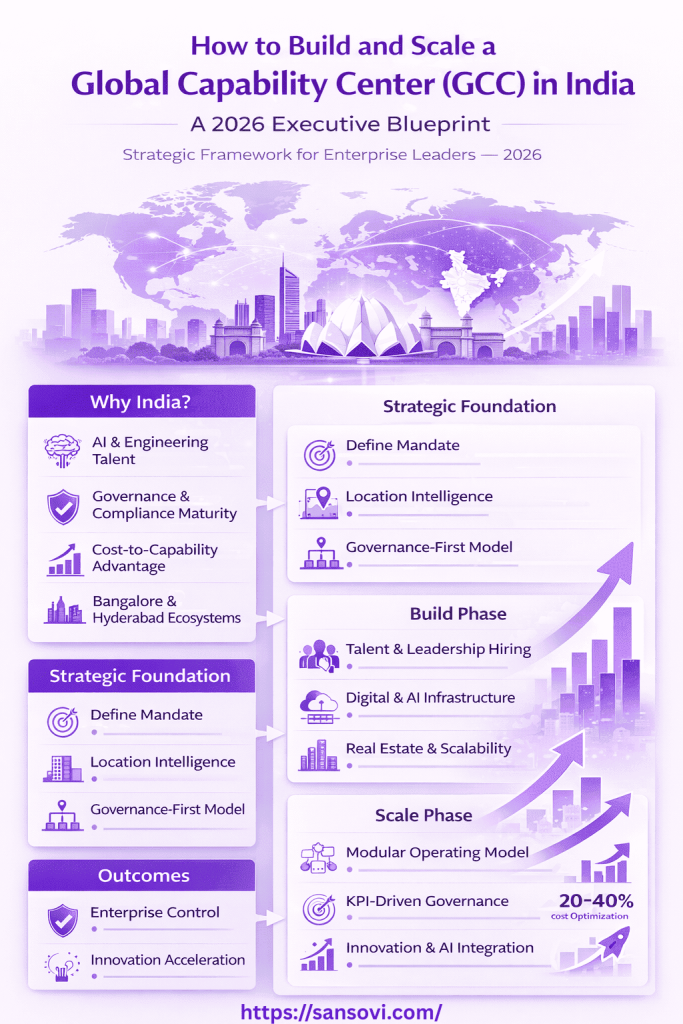
Enterprises typically achieve a 20–40% cost differential compared to onshore operations, but the greater return lies in innovation velocity and operational control.
A strategically designed global capability center (GCC) delivers long-term ROI through productivity gains, AI acceleration, and enterprise agility.
Phase 7: Scaling Without Structural Risk
Scaling from 200 employees to 2,000+ requires disciplined expansion.
To scale effectively:
-
Standardize processes early
-
Modularize organizational design
-
Maintain governance consistency
-
Align culture with headquarters
-
Integrate technology platforms globally
The most common failure point is uncontrolled growth without oversight.
A resilient global capability center (GCC) maintains structural clarity even as headcount and scope expand.
Performance Metrics for 2026
Measuring success requires broader metrics than cost savings.
Strategic KPIs include:
-
Innovation contribution to product roadmap
-
AI adoption maturity
-
Productivity improvement rates
-
Revenue influence or cost avoidance impact
-
Leadership pipeline strength
-
Retention and workforce stability
India-based operations should be evaluated as strategic assets tied to enterprise performance indicators.
The Executive Blueprint Summary
Building and scaling in India requires:
-
Defined strategic mandate
-
Ecosystem-aligned location choice
-
Governance-first design
-
Leadership-driven talent strategy
-
AI-enabled infrastructure
-
Structured financial modeling
-
Scalable organizational architecture
When executed correctly, the global capability center (GCC) becomes a long-term enterprise advantage — strengthening resilience, innovation, and global competitiveness.
Ready to Design Your 2026 India Strategy?




SansoviGCC by GoodWorks Group is India’s Leading End-to-End GCC Solutions Platform to build, operate and scale GCCs.


